AI Powered HR Payroll Software
How AI-Powered HR Payroll Software Is Transforming Employee Management
Managing employees has become more challenging than ever. Businesses today are expected to hire faster, process payroll accurately, ensure compliance, improve employee engagement, and make better workforce decisions—all while reducing operational costs. Doing all this manually is no longer practical.
This is where AI-powered HR payroll software is changing the game.
Artificial Intelligence (AI) helps businesses automate repetitive HR tasks, minimize payroll errors, enhance employee experiences, and provide valuable insights for smarter decision-making. Instead of spending countless hours on paperwork, HR professionals can focus on building stronger teams and creating a positive workplace culture.
Think of AI as a highly efficient assistant that never gets tired. Just as a GPS guides you through the fastest route while avoiding traffic, AI helps HR departments navigate complex workforce management by identifying the most efficient path forward.
Whether you’re a business owner, HR manager, or employee curious about workplace technology, understanding how AI is transforming HR and payroll can help you prepare for the future of work.
Introduction to AI in HR Payroll Software
Artificial Intelligence has rapidly become one of the most influential technologies across industries. In Human Resources, AI is simplifying everyday operations that once required significant manual effort.
Modern HR payroll software combines AI, automation, and analytics into one platform, allowing organizations to manage their workforce efficiently while delivering better employee experiences.
Instead of replacing HR professionals, AI supports them by handling repetitive administrative tasks and providing data-driven recommendations.
What Is AI-Powered HR Payroll Software?
AI-powered HR payroll software is an intelligent platform that automates HR and payroll functions using machine learning, predictive analytics, and automation technologies. These systems can manage:
- Payroll processing
- Employee records
- Attendance tracking
- Leave management
- Recruitment
- Performance evaluations
- Compliance monitoring
- Employee engagement
- Workforce analytics
Unlike traditional software that simply stores information, AI continuously learns from data and helps organizations make better decisions.
Why Traditional HR Systems Are No Longer Enough
Traditional HR systems often require manual data entry, repetitive approvals, and extensive paperwork. As businesses grow, these processes become slower and more prone to errors.
Common challenges include:
- Payroll mistakes
- Delayed salary processing
- Compliance risks
- Difficulty tracking employee performance
- Limited reporting capabilities
- Time-consuming recruitment
AI-powered systems solve these problems through automation, intelligent workflows, and real-time insights. This allows HR teams to spend more time supporting employees instead of managing spreadsheets.
Automated Payroll Processing
Payroll is one of the most critical HR responsibilities. Even a small mistake can impact employee trust and create legal issues. AI simplifies payroll by automatically:
- Calculating salaries
- Processing overtime
- Managing tax deductions
- Applying benefits
- Handling reimbursements
- Generating payslips
- Detecting payroll anomalies
Benefits of AI Payroll Automation
- Improves payroll accuracy
- Reduces manual calculations
- Minimizes human errors
- Processes payroll faster
- Ensures timely salary payments
- Maintains compliance with labor regulations
Employees receive accurate salaries on time, while HR teams experience significantly reduced workloads.
Smarter Recruitment and Hiring
Hiring the right employees is essential for business success. AI improves recruitment by analyzing resumes, matching candidates with job requirements, and reducing hiring bias through structured evaluations.
AI Recruitment Features
- Resume screening
- Candidate ranking
- Interview scheduling
- Skill matching
- Recruitment analytics
- Automated communication
Recruiters can focus on interviewing the best candidates rather than reviewing hundreds of applications manually.
AI-Driven Employee Onboarding
First impressions matter. A smooth onboarding process helps new employees become productive faster. AI-powered HR software automates:
- Document collection
- Digital signatures
- Policy acknowledgments
- Training assignments
- Equipment requests
- Welcome communications
New hires receive personalized onboarding experiences while HR avoids repetitive administrative work.
Attendance and Leave Management
Tracking attendance manually often leads to inaccuracies and disputes. AI-powered attendance systems integrate with:
- Biometric devices
- Mobile apps
- GPS tracking
- Facial recognition
- Online attendance portals
The software automatically:
- Records attendance
- Calculates working hours
- Tracks overtime
- Approves leave requests
- Updates payroll records
Employees also enjoy transparent access to their leave balances and attendance history.
Performance Management with AI
Traditional annual performance reviews are gradually being replaced with continuous performance management.
AI helps managers:
- Track employee goals
- Measure productivity
- Identify skill gaps
- Recommend learning programs
- Monitor performance trends
Benefits
- Objective evaluations
- Personalized development plans
- Higher employee engagement
- Better career planning
Managers receive real-time insights rather than relying solely on annual reviews.
Employee Self-Service and Virtual HR Assistants
Employees increasingly expect quick access to HR services. AI-powered employee self-service portals allow staff to:
- Download payslips
- Apply for leave
- Update personal information
- View attendance
- Access company policies
- Track benefits
Virtual HR assistants and chatbots can answer common questions instantly.
For example:
- “How many leave days do I have?”
- “When is payday?”
- “How can I update my bank account details?”
This reduces HR support requests while improving employee satisfaction.
Predictive Workforce Analytics
One of AI’s biggest advantages is its ability to predict future trends. Instead of simply reporting past events, AI identifies patterns that help organizations prepare for future workforce needs. Predictive analytics can forecast:
- Employee turnover
- Hiring requirements
- Training needs
- Productivity trends
- Absenteeism
- Workforce planning
Business leaders can make proactive decisions based on data rather than assumptions.
Compliance and Risk Management
Employment laws continue to evolve. Keeping up with payroll regulations, labor laws, tax requirements, and employee policies can be difficult. AI-powered HR payroll software automatically:
- Updates payroll rules
- Tracks regulatory changes
- Maintains audit trails
- Generates compliance reports
- Stores employee documentation
This reduces legal risks while ensuring organizations remain compliant.
Data Security and Privacy
HR departments manage highly sensitive employee information. AI-powered systems include advanced security features such as:
- Role-based access
- Multi-factor authentication
- Data encryption
- Secure cloud storage
- Continuous monitoring
- Suspicious activity detection
These features help protect confidential employee information from unauthorized access.
Business Benefits of AI-Powered HR Payroll Software
Organizations adopting AI-powered HR solutions experience significant improvements across multiple areas.
Improved Efficiency
Automation eliminates repetitive administrative work.
Higher Accuracy
AI reduces payroll and HR errors.
Better Employee Experience
Employees receive faster responses and convenient self-service options.
Cost Savings
Automation reduces operational expenses while improving productivity.
Smarter Decision-Making
Real-time dashboards and analytics provide actionable insights.
Scalability
Businesses can manage growing workforces without increasing HR workloads proportionally.
Overall, AI allows organizations to become more agile and competitive.
Future Trends in AI for HR Management
The future of AI in HR continues to evolve rapidly. Emerging innovations include:
Generative AI
AI will create job descriptions, training materials, and HR communications automatically.
Advanced Workforce Planning
Organizations will use predictive analytics for long-term workforce strategies.
Emotion and Sentiment Analysis
AI may help identify employee satisfaction trends through surveys and communication analysis.
Personalized Learning
Employees will receive customized training recommendations based on their career goals.
Smarter Workforce Automation
Routine HR tasks will become increasingly autonomous, allowing HR professionals to focus on strategic initiatives.
Businesses that embrace these technologies early will be better positioned for future growth.
Conclusion
AI-powered HR payroll software is transforming employee management by making HR operations faster, smarter, and more efficient. From payroll automation and intelligent recruitment to predictive analytics and employee self-service, AI is helping organizations simplify complex processes while improving employee experiences.
Rather than replacing HR professionals, AI empowers them to focus on what matters most—people. With reduced administrative work, improved compliance, enhanced decision-making, and better workforce insights, businesses can build stronger teams and create a more productive workplace.
As technology continues to advance, AI-powered HR payroll software will become an essential tool for organizations seeking long-term success in an increasingly competitive business environment.
Frequently Asked Questions (FAQs)
1. What is AI-powered HR payroll software?
AI-powered HR payroll software is a modern solution that uses artificial intelligence to automate payroll processing, employee management, recruitment, attendance tracking, compliance, and workforce analytics.
2. How does AI improve payroll accuracy?
AI automatically calculates salaries, taxes, overtime, deductions, and benefits while identifying potential errors before payroll is finalized, reducing manual mistakes.
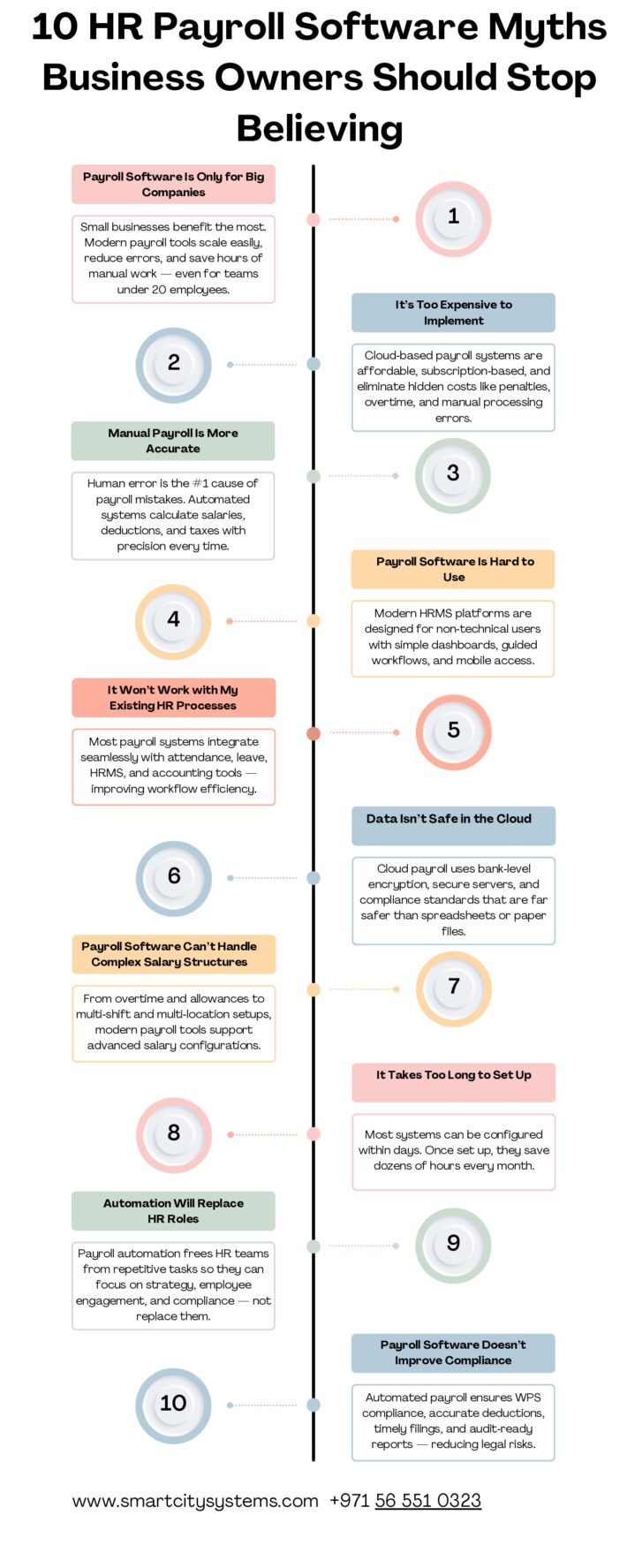
3. Can AI replace HR professionals?
No. AI supports HR professionals by automating repetitive tasks, allowing them to focus on employee engagement, strategic planning, talent development, and organizational growth.
4. Is AI-powered HR payroll software suitable for small businesses?
Yes. Small and medium-sized businesses benefit from improved efficiency, reduced administrative workload, accurate payroll processing, and scalable HR management without requiring large HR teams.
5. What are the biggest benefits of AI in employee management?
The biggest benefits include automated payroll, faster recruitment, improved compliance, real-time workforce analytics, better employee experiences, enhanced data security, and more informed business decisions.