10 HR Payroll Software Myths
10 HR Payroll Software Myths Business Owners Should Stop Believing
 Running a business is already challenging enough. Between handling employees, managing finances, and keeping customers happy, payroll can quickly become one of the most stressful responsibilities. Yet, many business owners still hesitate to adopt modern HR payroll software due to outdated beliefs and misinformation.
Some think payroll software is only for large corporations. Others believe it’s too expensive, too complicated, or even risky. The truth? These myths often prevent businesses from saving time, reducing errors, and improving employee satisfaction.
Think of HR software like GPS navigation for your business. You could still use an old paper map and hope for the best, but why struggle when smarter tools can guide you smoothly and efficiently?
In this article, we’ll break down the most common myths surrounding HR payroll software and explain why it’s time to leave them behind.
Introduction to HR Payroll Software
A digital tool called HR payroll software is used to process employee salaries, maintain attendance, manage leaves, compute taxes, and perform other HR-related functions. Instead of spending hours manually calculating salaries or correcting spreadsheet mistakes, businesses can streamline operations with just a few clicks.
Today, businesses of all sizes are using payroll software to improve efficiency, accuracy, and employee experience. Yet despite its growing popularity, many myths still surround these systems.
Let’s uncover the truth.
Why Payroll Management Matters
Payroll is more than simply paying employees on time. It directly impacts employee trust, legal compliance, and business reputation.
A small payroll mistake can create frustration among employees and even lead to penalties from authorities. Delayed salaries, incorrect deductions, or compliance issues can damage workplace morale quickly.
That’s why businesses need reliable systems that minimize human errors and improve transparency.
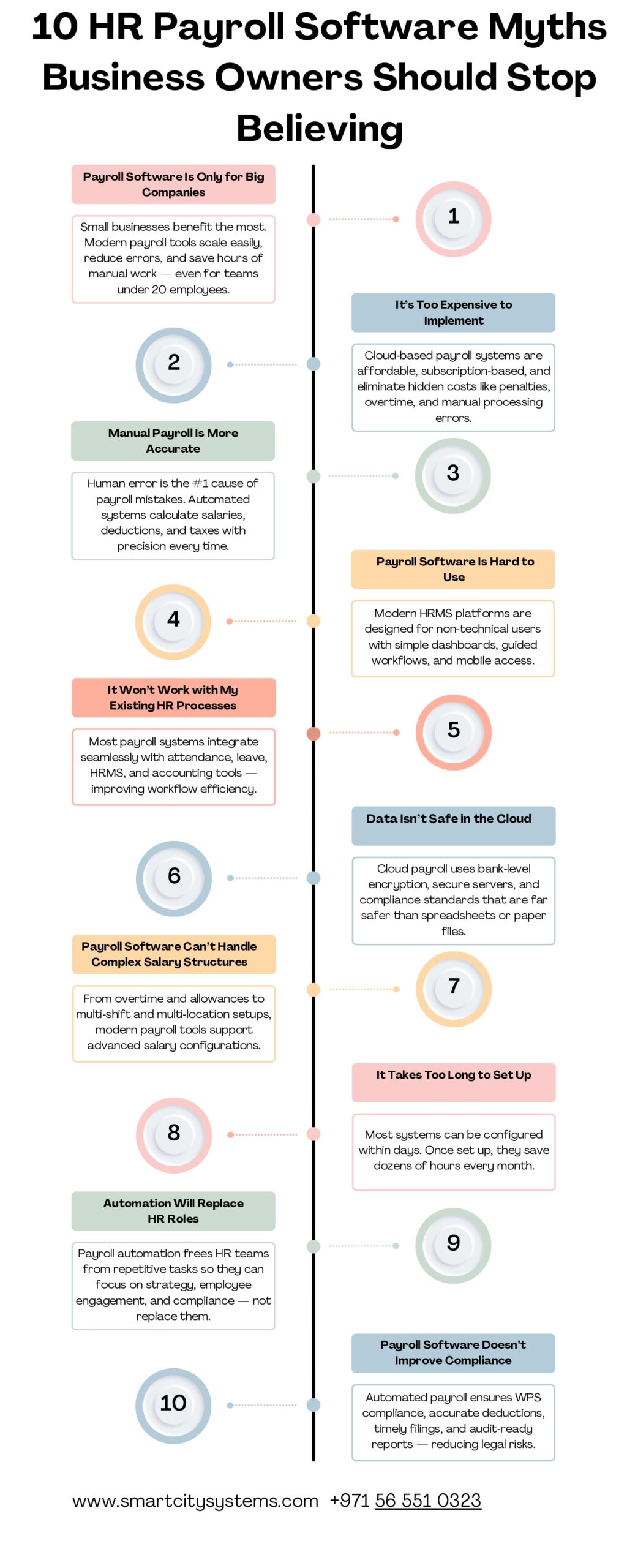
Myth #1 – Payroll Software Is Only for Large Companies
One of the biggest misconceptions is that HR software is designed only for big corporations with thousands of employees.
That’s simply not true.
Small and medium-sized businesses often benefit the most from payroll automation because they usually have limited HR staff and tighter schedules. Even a company with 10 employees can save significant time by automating salary calculations, leave tracking, and tax deductions.
All sizes of businesses can benefit from the scalable features and flexible pricing offered by modern payroll software.
The Truth
Payroll software helps businesses grow efficiently, regardless of company size.
Myth #2 – Payroll Software Is Too Expensive
Many business owners assume payroll systems are costly investments.
But when you compare the cost of software to the cost of payroll errors, compliance penalties, and lost productivity, the software often becomes the more affordable option.
Manual payroll processing consumes valuable hours every month. Time spent fixing errors or handling employee complaints also adds hidden costs.
Most cloud-based payroll systems now offer affordable subscription plans, making them accessible even for startups.
The Truth
Payroll software often saves more money than it costs.
Myth #3 – Manual Payroll Is More Reliable
Some business owners trust manual payroll because they feel “human control” reduces mistakes.
Ironically, manual payroll is usually more prone to errors.
Humans can easily miscalculate overtime, miss deductions, enter incorrect data, or forget compliance updates. Even a tiny spreadsheet mistake can create major payroll problems.
Automated payroll systems reduce repetitive tasks and improve calculation accuracy.
Common Manual Payroll Risks
- Incorrect salary calculations
- Missed tax deadlines
- Attendance errors
- Duplicate data entry
- Compliance violations
The Truth
Automation reduces payroll mistakes and improves consistency.
Myth #4: Payroll Software Is Hard to Use
Years ago, payroll systems were often complicated and required technical expertise. But modern HR software is designed with user-friendly dashboards and simple interfaces.
Most platforms allow HR teams to:
- Process payroll quickly
- Generate reports instantly
- Track attendance automatically
- Manage employee records digitally
Many solutions also provide training and customer support.
The Truth
Modern payroll software is designed for simplicity and ease of use.
Myth #5 – HR Payroll Software Replaces HR Teams
Some HR professionals worry that payroll automation will replace their jobs. In reality, payroll software doesn’t eliminate HR teams — it empowers them.
Instead of spending hours on repetitive calculations and paperwork, HR professionals can focus on more strategic tasks like employee engagement, recruitment, and performance management.
Think of payroll software as a helpful assistant, not a replacement.
The Truth
Payroll software helps HR departments by lightening their administrative burden.
Myth #6 – Cloud Payroll Systems Are Not Secure
Security concerns are understandable, especially when handling employee salary information. However, modern cloud-based payroll systems use advanced security measures such as:
- Data encryption
- Multi-factor authentication
- Secure backups
- Role-based access controls
In many cases, cloud systems are actually safer than storing payroll data in spreadsheets or physical files.
The Truth
Trusted cloud payroll systems provide strong data security and protection.
Myth #7 – Payroll Software Cannot Handle Compliance
Tax regulations and labor laws frequently change, making compliance difficult for businesses.
Some people assume payroll software cannot keep up with these updates.
The reality is quite the opposite.
Modern HR software is regularly updated to align with labor regulations, tax rules, and statutory requirements. Automated compliance tools help businesses avoid costly penalties and reporting mistakes.
Benefits of Compliance Automation
- Accurate tax calculations
- Timely reporting
- Reduced legal risks
- Better audit readiness
The Truth
Payroll software simplifies compliance management significantly.
Myth #8 – Switching Payroll Systems Is Complicated
Many businesses continue using outdated systems because they fear migration challenges.
Yes, switching systems requires planning, but modern payroll providers often offer migration assistance and onboarding support.
The transition process usually includes:
- Data transfer
- System setup
- Employee onboarding
- Training sessions
- Testing and verification
Most businesses complete migration smoothly with proper guidance.
The Truth
Switching payroll systems is easier than many businesses expect.
Myth #9: Payroll Software Doesn’t Help Workers
Some business owners think payroll software only helps management.
Actually, employees benefit greatly from automated HR systems.
Employee Benefits Include
- Faster salary processing
- Self-service portals
- Easy access to payslips
- Transparent leave balances
- Improved communication
Employees appreciate systems that provide clarity and convenience.
The Truth
Payroll software improves employee satisfaction and transparency.
Myth #10: Every Payroll Program Is the Same
Not all payroll systems offer the same features, flexibility, or support.
Some solutions focus only on payroll processing, while others include:
- Attendance management
- Recruitment tools
- Performance tracking
- Employee self-service
- Mobile access
- Analytics and reporting
Choosing the right system depends on your business needs, industry, and workforce size.
The Truth
Different payroll software solutions offer different capabilities and advantages.
Key Benefits of Modern HR Payroll Software
After dispelling the myths, let’s examine the benefits of payroll automation.
- Saves Time: Automated calculations and workflows reduce repetitive manual tasks.
- Improves Accuracy: Payroll software minimizes errors in salary calculations and deductions.
- Enhances Compliance: Businesses keep ahead of evolving labor and tax laws.
- Boosts Employee Experience: Payroll data and HR services are more easily accessible to employees.
- Supports Business Growth: Scalable systems grow alongside your organization.
- Better Reporting and Insights: Businesses can generate reports instantly for decision-making.
How to Choose the Right Payroll Solution
Choosing the right our software requires careful evaluation.
Look for These Features
- User-friendly interface
- Cloud accessibility
- Compliance support
- Employee self-service portal
- Integration capabilities
- Data security features
- Customer support availability
Questions to Ask Before Buying
- Does it support local labor laws?
- Can it scale with business growth?
- Is training included?
- How secure is employee data?
- Does it integrate with existing systems?
Taking the time to compare solutions can help businesses make smarter long-term decisions.
The Future of Payroll Management
Payroll technology continues to evolve rapidly. Artificial intelligence, automation, and cloud computing are making payroll systems smarter and more efficient.
Future payroll trends may include:
- AI-powered analytics
- Predictive workforce planning
- Real-time payroll processing
- Mobile-first HR management
- Advanced employee engagement tools
Companies that adopt digital transformation now will probably have an advantage over their competitors later on.
Conclusion
Believing outdated myths about HR software can hinder businesses from achieving growth, efficiency, and improved employee experiences.
Modern payroll systems are no longer expensive, complicated, or exclusive to large companies. They are practical tools that help businesses save time, reduce errors, maintain compliance, and improve workplace productivity.
Whether you run a startup, small business, or growing enterprise, investing in the right HR software can transform the way you manage your workforce.
The sooner businesses let go of these myths, the sooner they can focus on what truly matters — growing successfully and supporting their employees effectively.
FAQs
1. What is HR payroll software used for?
HR payroll software is used to automate salary processing, attendance tracking, leave management, tax calculations, and employee record management.
2. Is payroll software suitable for small businesses?
Yes, payroll software is highly beneficial for small businesses because it saves time, reduces errors, and improves efficiency.
3. Is cloud-based payroll software secure?
Most modern cloud payroll systems use advanced security technologies such as encryption and secure backups to protect sensitive employee data.
4. Can payroll software help with compliance?
Yes, with automated updates and computations, payroll software assists companies in adhering to labor rules, tax regulations, and reporting requirements.
5. How challenging is it to implement a new payroll system?
Switching payroll systems is usually straightforward when supported by proper onboarding, training, and migration assistance from the software provider.