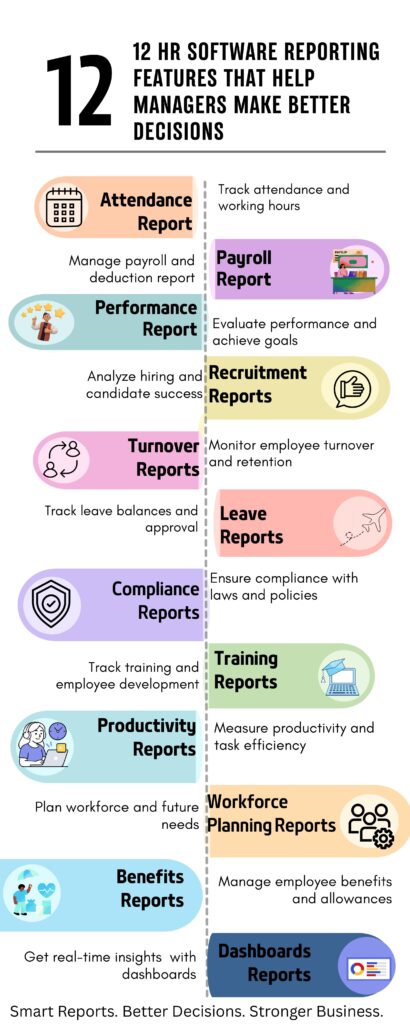
12 HR Software Reporting Features That Help Managers Make Better Decisions Managing employees without accurate data is like driving a car without a dashboard. You may keep moving, but you won’t know your speed, fuel level, or warning signs ahead. That’s exactly why HR software reporting features are important for modern businesses. Today’s managers need real-time insights to handle attendance, payroll, recruitment, employee performance, and compliance efficiently. HR software transforms raw employee data into meaningful reports that help organizations make smarter decisions faster. Instead of spending hours sorting out spreadsheets and paperwork, managers can access detailed reports with a few clicks. These reports improve productivity, reduce errors, and help businesses plan for future growth. In this article, we’ll explore exactly 12 HR software reporting features that help managers make better business decisions. Employee Attendance Reports Employee attendance reports help managers track working hours, late arrivals, overtime, and absenteeism. These reports improve workforce discipline and ensure accurate payroll processing. With automated attendance tracking, businesses can reduce manual errors and manage shifts more effectively. Additionally, managers are able to spot trends in attendance before they affect output. Key Benefits Improves punctuality Reduces time theft Supports accurate payroll Simplifies shift scheduling Payroll Reports Payroll reports provide complete salary details, deductions, bonuses, overtime calculations, and tax information. This reporting feature ensures employees are paid accurately and on time. Additionally, payroll reporting assists managers in keeping an eye on labor costs and upholding organizational financial integrity. Key Benefits Reduces payroll errors Simplifies tax calculations Tracks overtime costs Improves salary accuracy Performance Evaluation Reports Performance reports allow managers to measure employee achievements, goals, and overall productivity. Instead of relying on assumptions, businesses can evaluate employees using real data. These reports also support fair appraisals and employee development plans. Key Benefits Encourages employee growth Improves performance reviews Identifies skill gaps Supports fair promotions Recruitment and Hiring Reports Hiring reports help organizations analyze recruitment costs, candidate sources, and hiring success rates. Managers can easily identify which recruitment methods deliver the best results. This feature helps businesses hire the right people faster while reducing recruitment expenses. Key Benefits Improves hiring quality Reduces recruitment costs Tracks candidate performance Speeds up hiring decisions Employee Turnover Reports Employee turnover reports show how many employees leave the company and why. High turnover can increase hiring costs and affect productivity. By understanding resignation patterns, managers can improve employee satisfaction and retention strategies. Key Benefits Improves employee retention Identifies workplace issues Reduces hiring expenses Supports better engagement Leave Management Reports Leave reports track annual leave, sick leave, unpaid leave, and employee holiday balances. Managers can quickly view employee availability and avoid scheduling conflicts. Automated leave reporting makes approval processes faster and more organized. Key Benefits Prevents staffing shortages Simplifies leave approvals Improves workforce planning Ensures policy compliance Compliance Reports Compliance reporting helps businesses follow labor laws, company policies, and government regulations. These reports maintain accurate employee records for audits and legal purposes. Organizations can avoid penalties and maintain transparency with automated compliance tracking. Key Benefits Reduces legal risks Supports audits Maintains accurate records Improves policy compliance Training and Development Reports Training reports help managers track employee learning progress, certifications, and completed courses. This feature ensures employees receive proper skill development opportunities. Businesses can also identify training gaps and improve workforce capabilities. Key Benefits Tracks employee learning Identifies skill shortages Improves workforce development Supports career growth Employee Productivity Reports Task completion, project performance, and personnel efficiency are all measured by productivity reports. Managers can identify high-performing employees and detect workflow problems quickly. It helps companies track performance and continuously increase efficiency, much like a fitness tracker for your employees. Key Benefits Improves task management Increases accountability Enhances team performance Identifies workflow delays Workforce Planning Reports Workforce planning reports help organizations forecast future staffing requirements and resource allocation. Managers can prepare for expansion, seasonal demand, or organizational restructuring. This reporting feature supports smarter long-term business planning. Key Benefits Supports future planning Prevents understaffing Controls labor costs Improves resource management Benefits Administration Reports Benefits reports help businesses manage employee insurance, bonuses, allowances, and retirement plans efficiently. Managers can analyze benefit usage and control overall costs. Providing the right employee benefits also improves job satisfaction and retention. Key Benefits Improves employee satisfaction Tracks benefits costs Simplifies administration Ensures accurate enrollment Real-Time Dashboard Reports Real-time dashboard reporting provides instant access to key HR metrics through visual charts and summaries. Managers can monitor attendance, payroll, hiring, and performance data from one centralized dashboard. Without having to wait for manual reports, this capability enables organizations to make decisions more quickly and intelligently. Key Benefits Provides instant insights Improves decision-making Enhances data visibility Supports real-time monitoring Conclusion HR software reporting features play a major role in helping businesses manage employees more effectively. From payroll tracking to workforce planning, these tools provide accurate insights that improve decision-making and business performance. Managers no longer need to rely on manual spreadsheets or guesswork. With the right HR reporting features, businesses can improve productivity, reduce errors, increase employee satisfaction, and plan for future growth with confidence. As companies continue to grow, investing in advanced HR software reporting tools can become one of the smartest business decisions for long-term success. FAQs 1. What are HR software reporting features? HR software reporting features are tools that generate detailed employee-related reports such as payroll, attendance, recruitment, and performance analysis. 2. Why are HR reports important for managers? HR reports help managers make informed decisions using accurate employee data and workforce insights. 3. Can HR software reduce payroll mistakes? Yes, HR software automates payroll calculations and reporting, reducing manual errors significantly. 4. How do attendance reports help businesses? Attendance reports improve workforce discipline, track working hours, and support accurate payroll processing. 5. What is the main advantage of real-time HR dashboards? Real-time dashboards provide instant access to important HR data, helping managers respond quickly and make faster decisions.
HR Software Solution
Role of AI in Modern HR Software Solutions Introduction Have you ever wondered how companies today manage thousands of employees without drowning in paperwork? Or how do they seem to hire the perfect candidate faster than ever? The answer often lies in Artificial Intelligence (AI). AI is no longer just a futuristic idea—it’s actively shaping how businesses handle their workforce. From hiring and onboarding to performance tracking and employee engagement, AI is becoming the backbone of modern HR software solutions. Think of it like a smart assistant that never sleeps, constantly learning, and helping HR teams make better decisions. In this article, we’ll explore how AI is revolutionizing HR, why it matters, and how it impacts both businesses and employees in everyday life. Understanding AI in HR Artificial Intelligence in HR refers to the use of smart algorithms and data-driven tools to automate and improve human resource processes. Instead of relying solely on manual decisions, HR teams now use AI to analyze data, identify patterns, and make informed choices. Platforms like Workday and SAP SuccessFactors are leading examples of how AI is integrated into HR systems. Why AI Matters in Modern HR Why is everyone talking about AI in HR? Because it solves real problems: Saves time on repetitive tasks Improves hiring accuracy Enhances employee experience Provides data-backed insights Imagine trying to find a needle in a haystack—that’s what hiring used to feel like. AI acts like a magnet, quickly pulling out the best candidates. AI-Powered Recruitment Recruitment is one of the biggest areas where AI shines. AI tools can: In just a few seconds, scan thousands of resumes Match candidates with job requirements Rank applicants based on skills and experience This means HR teams spend less time sorting resumes and more time connecting with the right people. Smart Candidate Screening Screening candidates manually is time-consuming. AI changes that. Modern HR systems use AI to: Analyze resumes Conduct initial chatbot interviews Evaluate communication skills These tools ensure that only the most suitable candidates move forward in the hiring process. AI in Employee Onboarding First impressions matter, right? AI-powered onboarding tools help new employees: Complete documentation digitally Access personalized training plans Get instant answers through chatbots This creates a smooth and welcoming experience from day one. Performance Management with AI The days of yearly performance assessments are long gone. AI makes it possible to track performance in real time by: Monitoring employee progress Providing continuous feedback Identifying strengths and weaknesses It’s like having a personal coach guiding employees throughout their journey. Predictive Analytics in HR What if HR could predict the future? With AI, it almost can. Predictive analytics helps: Identify employees likely to leave Forecast hiring needs Plan workforce strategies This allows companies to act proactively rather than reactively. Enhancing Employee Engagement Engaged employees are happy employees—and happy employees are productive. AI tools analyze: Employee feedback Work patterns Satisfaction levels Based on this data, HR teams can take steps to improve workplace culture. AI in Learning and Development Learning is no longer one-size-fits-all. AI personalizes training by: Recommending courses based on roles Tracking learning progress Suggesting skill improvements It’s like having a custom learning path tailored just for you. Automating Payroll and Admin Tasks Let’s be honest—no one enjoys repetitive administrative work. AI automates: Payroll processing Attendance tracking Leave management This lowers mistakes and frees up time for more strategic work. Reducing Bias with AI Human decisions can sometimes be biased—intentionally or not. AI helps by: Focusing on skills and data Ignoring irrelevant personal details Ensuring fair hiring practices However, it’s important to design AI systems carefully to avoid hidden biases. Challenges of AI in HR AI isn’t perfect. It comes with challenges like: Data privacy concerns High implementation costs Need for proper training Risk of over-reliance on technology Organizations must balance technology with human judgment. Future of AI in HR Software The future looks exciting. We can expect: More advanced chatbots Fully automated HR processes Better predictive insights Enhanced employee experiences AI will continue to evolve, making HR smarter and more efficient. Choosing the Right AI HR Solution Not every AI HR tool is made equally. When selecting a solution, consider: Ease of use Integration capabilities Data security Customization options The right tool can transform your HR operations completely. Conclusion AI is no longer just an add-on—it’s becoming essential in modern HR software solutions. From hiring the right talent to improving employee engagement, AI is reshaping how organizations manage their workforce. Think of AI as a co-pilot for HR teams. It doesn’t replace humans but enhances their ability to make smarter decisions. As businesses continue to grow and evolve, AI will play an even bigger role in shaping the future of work. FAQs 1. What is AI in HR software? AI in HR software uses smart algorithms to automate and improve HR processes like recruitment, onboarding, and performance management. 2. How does AI improve recruitment? AI speeds up recruitment by analyzing resumes, matching candidates to job roles, and reducing manual screening efforts. 3. Can AI replace HR professionals? No, AI supports HR professionals by automating tasks, but human judgment and interaction remain essential. 4. Is AI in HR secure? Yes, but organizations must ensure proper data security measures and compliance with privacy regulations. 5. What are the benefits of AI in HR? AI improves efficiency, reduces errors, enhances employee experience, and provides valuable insights for decision-making.
A Smarter Way to Manage HR
SmartHR by SmartCitySystems.com: A Smarter Way to Manage HR In today’s fast-moving business world, manual HR processes simply can’t keep up. From attendance tracking and payroll to performance reviews and compliance, HR teams are juggling a lot—and doing it all by hand increases the risk of errors, delays, and inefficiency. That’s where SmartHR from SmartCitySystems.com makes a difference. It’s a complete, cloud-based HR software solution designed to simplify, automate, and modernize the way your company manages its people. Whether you’re a small business or a fast-growing enterprise, SmartHR helps you save time, stay compliant, and focus on building a stronger, more productive team. What Is SmartHR? SmartHR is an easy-to-use, all-in-one HR software platform that brings your entire HR operation into one secure digital space. Payroll, performance reviews, onboarding, attendance, and more are all covered. Built for businesses in the UAE and beyond, SmartHR adapts to your company’s size and needs. It grows as you grow—and helps your HR team focus on people, not paperwork. Why You Need a Unified HR System Businesses today face increasing pressure to manage talent efficiently while ensuring compliance with labor laws. At the same time, employees expect seamless onboarding, real-time access to information, and timely payroll. SmartHR helps address all of that by: Cutting down manual tasks and admin time Reducing errors in payroll and data entry Helping you meet labor regulations and tax deadlines Improving the employee experience Giving HR teams the tools to focus on strategy instead of operations What You Get with SmartHR Here’s a closer look at the key features: Onboarding and Employee Records Get new hires set up quickly with digital document collection, task assignments, and automated workflows. Store employee information securely in one place—easily accessible to HR and relevant managers. Attendance and Time Tracking Track time accurately using web check-ins, mobile GPS, or shift schedules. Whether your team works on-site, remotely, or in the field, SmartHR ensures reliable attendance records. Payroll and Compliance Automate salary calculations, tax deductions, and payslip generation. Handle bonuses, incentives, and WPS compliance with ease. Leave Management Customize leave policies, allow mobile or desktop applications, and link everything to payroll automatically for a seamless process. Performance Management Define goals, manage appraisals, and run evaluations. Structured performance reviews and ongoing feedback are supported by SmartHR. Employee Self-Service Let employees handle routine tasks like viewing payslips, updating personal info, or submitting leave requests. Employees have more control and HR’s workload is lessened. Reports and Analytics Use visual dashboards to track attendance trends, payroll costs, retention, and more. Make informed decisions backed by real data. Why SmartHR Works for Any Business Saves Time – Automates key tasks so HR teams can focus on high-value work Improves Accuracy – Eliminates manual errors in payroll, taxes, and reporting Scales Easily – Works just as well for 10 employees as it does for 1,000 Accessible Anywhere – Cloud-based with mobile-friendly access Keeps You Compliant – Stay up to date with local labor laws and WPS regulations Better Employee Experience – Makes it easier for your team to access the info they need SmartHR Supports Modern Work Environments Since remote and hybrid work are more common, SmartHR is designed to be flexible: Mobile attendance with GPS and geofencing Cloud access to documents and HR tools Remote performance management and payroll processing Real-time notifications and updates Customizable and Easy to Integrate SmartHR works well with your existing tools—ERP, accounting software, biometric devices, and more. Workflows, approvals, and policies can be modified to suit the needs of your company. Whether you need a simple payroll system or a full HR suite, SmartHR can be configured to meet your requirements. Proven Across Industries SmartHR is used by businesses in: Retail, for managing rosters and attendance across branches Healthcare, for coordinating staff across shifts and facilities Construction, to monitor field workers and guarantee adherence to labor laws IT and tech, to support remote teams and automate payroll Education, to handle staff records, contracts, and leave management What Sets SmartHR Apart Developed for modern UAE businesses, with global scalability Simple and clean user interface Fast to deploy, easy to train on Affordable pricing and strong ROI Dedicated support team and regular updates Take the Next Step SmartHR is designed to make HR simpler and more efficient—so your team can focus on growing your business. Whether you’re moving from spreadsheets or upgrading from older systems, we’re here to make the transition smooth and stress-free. Visit www.SmartCitySystems.com to learn more or book a free demo. Closing Thoughts HR software is becoming a necessity rather than a luxury. SmartHR helps your business stay organized, compliant, and ready for the future. From automating admin tasks to improving employee satisfaction, it brings real value to your day-to-day operations. If you’re ready to modernize how your business manages people, SmartHR is ready to help.
SmartHR
SmartHR: Your All-in-One HR Management Solution Managing a workforce in today’s fast-paced digital world isn’t as straightforward as it used to be. With hybrid teams, increasing compliance demands, and the rising expectations of employees, traditional HR methods are no longer enough. Businesses need a smarter, more agile way to handle everything from onboarding and payroll to performance tracking and employee engagement. Enter SmartHR—a modern, cloud-based HR management system designed to make your workforce operations more efficient, insightful, and scalable. Whether you’re a small business or a large enterprise, SmartHR transforms how you manage people, processes, and performance. Let’s explore why SmartHR is the smarter way to manage your workforce. The HR Challenges Facing Today’s Businesses HR professionals and business leaders are facing a new set of challenges: Manual paperwork and inefficient systems Disconnected tools for payroll, leave, and attendance Compliance risks due to outdated processes Poor visibility into team performance Time-consuming onboarding and offboarding Lack of support for remote and hybrid teams These issues can result in high turnover, costly mistakes, and an overwhelmed HR team. Most importantly, they drain time and resources that could be better spent on strategic growth. SmartHR was developed with these pain points in mind. It empowers organizations to modernize their HR operations—without the complexity or cost of enterprise software suites. What Is SmartHR? SmartHR is an all-in-one human resource management system (HRMS) built for today’s workforce dynamics. It brings together core HR functions—like employee data, payroll, leave, time tracking, and performance—in a single, user-friendly platform. It’s cloud based HR software, mobile-accessible, and incredibly intuitive. Key highlights include: A centralized dashboard for HR management Automation of repetitive HR tasks Real-time visibility into employee performance and attendance Seamless integration with existing payroll systems HR managers and employees can use mobile apps when they’re on the go. Whether you’re managing 10 people or 1,000, SmartHR is scalable to meet your growing needs—without overcomplicating your operations. Key Features That Make SmartHR Smarter Let’s dive into the powerful features that make SmartHR a game-changer for workforce management. 1. Automated Onboarding and Offboarding Say goodbye to paper forms and long checklists. The complete onboarding and offboarding procedure is automated by SmartHR: Assign tasks to IT, finance, and admin teams Collect employee documents digitally Provide new hires with self-service access to fill in details Generate offer letters and exit formalities automatically This not only saves time but ensures a smooth experience for employees from day one until their last. 2. Smart Attendance and Leave Tracking Whether your staff members are working remotely, on-site, or on vacation, SmartHR guarantees perfect attendance tracking: Geo-fencing and GPS check-in via mobile apps Biometric and kiosk integrations Customizable leave policies and approvals Auto leave balance updates and reporting This results in reduced time theft, increased accountability, and fewer payroll errors. 3. Payroll Integration and Compliance SmartHR simplifies one of the most complex HR tasks—payroll processing. Automate salary calculations based on attendance, leaves, and tax settings Generate payslips and payment summaries instantly Ensure statutory compliance with tax laws, superannuation, and labor regulations Maintain audit trails and historical records This translates into more time spent on planning and less time spent crunching numbers. 4. Performance Management Tools Motivate your employees and align them with business goals through SmartHR’s robust performance management system: Create individual and team goals Track achievements and feedback in real time Schedule review cycles and performance appraisals Use visual dashboards to monitor progress Data-driven performance insights help managers recognize top talent and address underperformance early. 5. Employee Self-Service Portal Empower your employees with transparency and control: Update personal details without HR assistance Apply for leave, download payslips, and view attendance Access company policies, documents, and announcements This reduces HR workload while boosting employee satisfaction. 6. Mobile Access and Cloud Convenience SmartHR is designed for today’s mobile-first world: Manage HR tasks from your phone or tablet Access real-time data from anywhere Ensure business continuity with cloud backup and updates No more waiting to get back to the office—HR can happen anywhere. Top Benefits of Using SmartHR Adopting SmartHR delivers both immediate and long-term advantages: ✔ Time and Cost Savings Automating routine tasks like onboarding, payroll, and attendance frees up HR teams to focus on strategic initiatives. ✔ Increased Accuracy With integrated data flows, you can eliminate double entry and reduce human errors in payroll and compliance. ✔ Stronger Compliance Stay up-to-date with local labor laws, tax regulations, and reporting requirements. ✔ Enhanced Employee Experience Employees enjoy smoother onboarding, faster approvals, and 24/7 access to their records. ✔ Better Insights Leverage real-time hr analytics reports and dashboards to make smarter workforce decisions. According to internal user data, companies using SmartHR report up to 40% faster HR workflows, 30% fewer errors, and a 25% increase in employee satisfaction scores. Who Can Benefit from SmartHR? SmartHR is industry-agnostic and adaptable. Whether you’re in healthcare, retail, hospitality, logistics, or professional services, SmartHR can help you modernize your workforce operations. Here are a few real-world use cases: Startups & SMEs: Fast-growing businesses that need scalable HR without a dedicated HR team. Multi-Location Companies: Centralize HR across offices, branches, and remote teams. Enterprises: Streamline compliance, performance tracking, and employee engagement. One client, a regional logistics company, reduced onboarding time from 7 days to 3 using SmartHR’s automated task flows. Another, a multi-store retail chain, cut payroll processing errors by over 60% in just two months. Easy Implementation and Exceptional Support We know switching HR systems can be intimidating. That’s why SmartHR is designed for quick deployment with minimal disruption. Our onboarding includes: Guided setup and migration from legacy systems Role-based training for HR teams and employees Custom workflows tailored to your business Dedicated customer success managers and live chat support You don’t have to go it alone—we’re with you every step of the way. Why Now Is the Right Time to Switch to SmartHR The way we work is changing fast. The pressure to attract and retain talent, ensure compliance, and operate efficiently has never been greater. Delaying your HR transformation