
How AI-Powered HR Payroll Software Is Transforming Employee Management Managing employees has become more challenging than ever. Businesses today are expected to hire faster, process payroll accurately, ensure compliance, improve employee engagement, and make better workforce decisions—all while reducing operational costs. Doing all this manually is no longer practical. This is where AI-powered HR payroll software is changing the game. Artificial Intelligence (AI) helps businesses automate repetitive HR tasks, minimize payroll errors, enhance employee experiences, and provide valuable insights for smarter decision-making. Instead of spending countless hours on paperwork, HR professionals can focus on building stronger teams and creating a positive workplace culture. Think of AI as a highly efficient assistant that never gets tired. Just as a GPS guides you through the fastest route while avoiding traffic, AI helps HR departments navigate complex workforce management by identifying the most efficient path forward. Whether you’re a business owner, HR manager, or employee curious about workplace technology, understanding how AI is transforming HR and payroll can help you prepare for the future of work. Introduction to AI in HR Payroll Software Artificial Intelligence has rapidly become one of the most influential technologies across industries. In Human Resources, AI is simplifying everyday operations that once required significant manual effort. Modern HR payroll software combines AI, automation, and analytics into one platform, allowing organizations to manage their workforce efficiently while delivering better employee experiences. Instead of replacing HR professionals, AI supports them by handling repetitive administrative tasks and providing data-driven recommendations. What Is AI-Powered HR Payroll Software? AI-powered HR payroll software is an intelligent platform that automates HR and payroll functions using machine learning, predictive analytics, and automation technologies. These systems can manage: Payroll processing Employee records Attendance tracking Leave management Recruitment Performance evaluations Compliance monitoring Employee engagement Workforce analytics Unlike traditional software that simply stores information, AI continuously learns from data and helps organizations make better decisions. Why Traditional HR Systems Are No Longer Enough Traditional HR systems often require manual data entry, repetitive approvals, and extensive paperwork. As businesses grow, these processes become slower and more prone to errors. Common challenges include: Payroll mistakes Delayed salary processing Compliance risks Difficulty tracking employee performance Limited reporting capabilities Time-consuming recruitment AI-powered systems solve these problems through automation, intelligent workflows, and real-time insights. This allows HR teams to spend more time supporting employees instead of managing spreadsheets. Automated Payroll Processing Payroll is one of the most critical HR responsibilities. Even a small mistake can impact employee trust and create legal issues. AI simplifies payroll by automatically: Calculating salaries Processing overtime Managing tax deductions Applying benefits Handling reimbursements Generating payslips Detecting payroll anomalies Benefits of AI Payroll Automation Improves payroll accuracy Reduces manual calculations Minimizes human errors Processes payroll faster Ensures timely salary payments Maintains compliance with labor regulations Employees receive accurate salaries on time, while HR teams experience significantly reduced workloads. Smarter Recruitment and Hiring Hiring the right employees is essential for business success. AI improves recruitment by analyzing resumes, matching candidates with job requirements, and reducing hiring bias through structured evaluations. AI Recruitment Features Resume screening Candidate ranking Interview scheduling Skill matching Recruitment analytics Automated communication Recruiters can focus on interviewing the best candidates rather than reviewing hundreds of applications manually. AI-Driven Employee Onboarding First impressions matter. A smooth onboarding process helps new employees become productive faster. AI-powered HR software automates: Document collection Digital signatures Policy acknowledgments Training assignments Equipment requests Welcome communications New hires receive personalized onboarding experiences while HR avoids repetitive administrative work. Attendance and Leave Management Tracking attendance manually often leads to inaccuracies and disputes. AI-powered attendance systems integrate with: Biometric devices Mobile apps GPS tracking Facial recognition Online attendance portals The software automatically: Records attendance Calculates working hours Tracks overtime Approves leave requests Updates payroll records Employees also enjoy transparent access to their leave balances and attendance history. Performance Management with AI Traditional annual performance reviews are gradually being replaced with continuous performance management. AI helps managers: Track employee goals Measure productivity Identify skill gaps Recommend learning programs Monitor performance trends Benefits Objective evaluations Personalized development plans Higher employee engagement Better career planning Managers receive real-time insights rather than relying solely on annual reviews. Employee Self-Service and Virtual HR Assistants Employees increasingly expect quick access to HR services. AI-powered employee self-service portals allow staff to: Download payslips Apply for leave Update personal information View attendance Access company policies Track benefits Virtual HR assistants and chatbots can answer common questions instantly. For example: “How many leave days do I have?” “When is payday?” “How can I update my bank account details?” This reduces HR support requests while improving employee satisfaction. Predictive Workforce Analytics One of AI’s biggest advantages is its ability to predict future trends. Instead of simply reporting past events, AI identifies patterns that help organizations prepare for future workforce needs. Predictive analytics can forecast: Employee turnover Hiring requirements Training needs Productivity trends Absenteeism Workforce planning Business leaders can make proactive decisions based on data rather than assumptions. Compliance and Risk Management Employment laws continue to evolve. Keeping up with payroll regulations, labor laws, tax requirements, and employee policies can be difficult. AI-powered HR payroll software automatically: Updates payroll rules Tracks regulatory changes Maintains audit trails Generates compliance reports Stores employee documentation This reduces legal risks while ensuring organizations remain compliant. Data Security and Privacy HR departments manage highly sensitive employee information. AI-powered systems include advanced security features such as: Role-based access Multi-factor authentication Data encryption Secure cloud storage Continuous monitoring Suspicious activity detection These features help protect confidential employee information from unauthorized access. Business Benefits of AI-Powered HR Payroll Software Organizations adopting AI-powered HR solutions experience significant improvements across multiple areas. Improved Efficiency Automation eliminates repetitive administrative work. Higher Accuracy AI reduces payroll and HR errors. Better Employee Experience Employees receive faster responses and convenient self-service options. Cost Savings Automation reduces operational expenses while improving productivity. Smarter Decision-Making Real-time dashboards and analytics provide actionable insights. Scalability Businesses can manage growing workforces without increasing HR workloads proportionally. Overall, AI allows organizations to become more agile and competitive. Future Trends in AI for HR Management The future of AI in HR continues to evolve rapidly. Emerging innovations include: Generative AI AI will create job descriptions, training materials, and HR communications automatically. Advanced Workforce Planning Organizations will use predictive analytics for long-term workforce strategies. Emotion and Sentiment Analysis AI
10 HR Payroll Software Myths
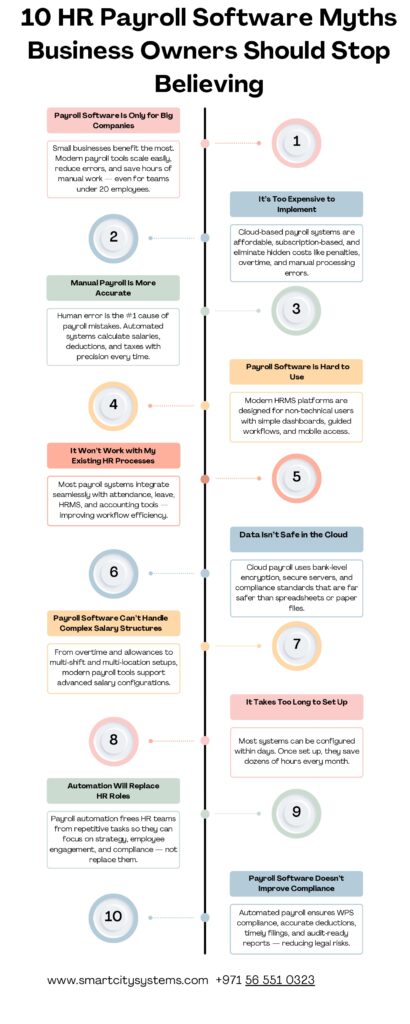
10 HR Payroll Software Myths Business Owners Should Stop Believing Running a business is already challenging enough. Between handling employees, managing finances, and keeping customers happy, payroll can quickly become one of the most stressful responsibilities. Yet, many business owners still hesitate to adopt modern HR payroll software due to outdated beliefs and misinformation. Some think payroll software is only for large corporations. Others believe it’s too expensive, too complicated, or even risky. The truth? These myths often prevent businesses from saving time, reducing errors, and improving employee satisfaction. Think of HR software like GPS navigation for your business. You could still use an old paper map and hope for the best, but why struggle when smarter tools can guide you smoothly and efficiently? In this article, we’ll break down the most common myths surrounding HR payroll software and explain why it’s time to leave them behind. Introduction to HR Payroll Software A digital tool called HR payroll software is used to process employee salaries, maintain attendance, manage leaves, compute taxes, and perform other HR-related functions. Instead of spending hours manually calculating salaries or correcting spreadsheet mistakes, businesses can streamline operations with just a few clicks. Today, businesses of all sizes are using payroll software to improve efficiency, accuracy, and employee experience. Yet despite its growing popularity, many myths still surround these systems. Let’s uncover the truth. Why Payroll Management Matters Payroll is more than simply paying employees on time. It directly impacts employee trust, legal compliance, and business reputation. A small payroll mistake can create frustration among employees and even lead to penalties from authorities. Delayed salaries, incorrect deductions, or compliance issues can damage workplace morale quickly. That’s why businesses need reliable systems that minimize human errors and improve transparency. Myth #1 – Payroll Software Is Only for Large Companies One of the biggest misconceptions is that HR software is designed only for big corporations with thousands of employees. That’s simply not true. Small and medium-sized businesses often benefit the most from payroll automation because they usually have limited HR staff and tighter schedules. Even a company with 10 employees can save significant time by automating salary calculations, leave tracking, and tax deductions. All sizes of businesses can benefit from the scalable features and flexible pricing offered by modern payroll software. The Truth Payroll software helps businesses grow efficiently, regardless of company size. Myth #2 – Payroll Software Is Too Expensive Many business owners assume payroll systems are costly investments. But when you compare the cost of software to the cost of payroll errors, compliance penalties, and lost productivity, the software often becomes the more affordable option. Manual payroll processing consumes valuable hours every month. Time spent fixing errors or handling employee complaints also adds hidden costs. Most cloud-based payroll systems now offer affordable subscription plans, making them accessible even for startups. The Truth Payroll software often saves more money than it costs. Myth #3 – Manual Payroll Is More Reliable Some business owners trust manual payroll because they feel “human control” reduces mistakes. Ironically, manual payroll is usually more prone to errors. Humans can easily miscalculate overtime, miss deductions, enter incorrect data, or forget compliance updates. Even a tiny spreadsheet mistake can create major payroll problems. Automated payroll systems reduce repetitive tasks and improve calculation accuracy. Common Manual Payroll Risks Incorrect salary calculations Missed tax deadlines Attendance errors Duplicate data entry Compliance violations The Truth Automation reduces payroll mistakes and improves consistency. Myth #4: Payroll Software Is Hard to Use Years ago, payroll systems were often complicated and required technical expertise. But modern HR software is designed with user-friendly dashboards and simple interfaces. Most platforms allow HR teams to: Process payroll quickly Generate reports instantly Track attendance automatically Manage employee records digitally Many solutions also provide training and customer support. The Truth Modern payroll software is designed for simplicity and ease of use. Myth #5 – HR Payroll Software Replaces HR Teams Some HR professionals worry that payroll automation will replace their jobs. In reality, payroll software doesn’t eliminate HR teams — it empowers them. Instead of spending hours on repetitive calculations and paperwork, HR professionals can focus on more strategic tasks like employee engagement, recruitment, and performance management. Think of payroll software as a helpful assistant, not a replacement. The Truth Payroll software helps HR departments by lightening their administrative burden. Myth #6 – Cloud Payroll Systems Are Not Secure Security concerns are understandable, especially when handling employee salary information. However, modern cloud-based payroll systems use advanced security measures such as: Data encryption Multi-factor authentication Secure backups Role-based access controls In many cases, cloud systems are actually safer than storing payroll data in spreadsheets or physical files. The Truth Trusted cloud payroll systems provide strong data security and protection. Myth #7 – Payroll Software Cannot Handle Compliance Tax regulations and labor laws frequently change, making compliance difficult for businesses. Some people assume payroll software cannot keep up with these updates. The reality is quite the opposite. Modern HR software is regularly updated to align with labor regulations, tax rules, and statutory requirements. Automated compliance tools help businesses avoid costly penalties and reporting mistakes. Benefits of Compliance Automation Accurate tax calculations Timely reporting Reduced legal risks Better audit readiness The Truth Payroll software simplifies compliance management significantly. Myth #8 – Switching Payroll Systems Is Complicated Many businesses continue using outdated systems because they fear migration challenges. Yes, switching systems requires planning, but modern payroll providers often offer migration assistance and onboarding support. The transition process usually includes: Data transfer System setup Employee onboarding Training sessions Testing and verification Most businesses complete migration smoothly with proper guidance. The Truth Switching payroll systems is easier than many businesses expect. Myth #9: Payroll Software Doesn’t Help Workers Some business owners think payroll software only helps management. Actually, employees benefit greatly from automated HR systems. Employee Benefits Include Faster salary processing Self-service portals Easy access to payslips Transparent leave balances Improved communication Employees appreciate systems that provide clarity and convenience. The Truth Payroll software improves employee satisfaction and transparency. Myth #10: Every Payroll Program Is the Same Not all payroll systems offer the same features, flexibility, or support. Some solutions focus only on payroll processing, while others include: Attendance management Recruitment tools Performance tracking Employee self-service Mobile access